
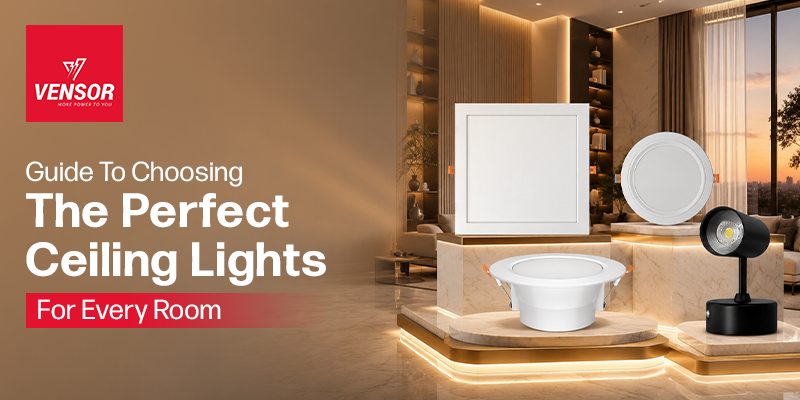
Most people spend hours choosing the right paint colour or sofa fabric, but give their ceiling lights almost no thought at all. Yet lighting is the one element that ties everything together. It changes how colours look, how large a room feels, and how comfortable you are inside it. Get it right, and the entire space comes alive. Get it wrong, and no amount of good furniture will save it.
If you have ever walked into a room that felt inexplicably off despite looking well put together, there is a good chance the lighting was the problem. So, if you’re going to buy wholesale led bulbs for your space, this guide will help you avoid exactly that, room by room.
Three Things to Understand Before You Choose Any Light
Colour Temperature
Measured in Kelvin (K), colour temperature tells you whether a light will feel warm and cosy or bright and clinical. Below 3000K sits the warm white range: soft, golden toned, and easy to relax under. Between 3000K and 4500K is neutral white, clean and balanced for everyday use. Above 5000K is cool or daylight white, sharp and stimulating.
Brightness (Lumens, Not Watts)
Wattage tells you how much energy a bulb consumes, not how bright it is. Lumens measure actual brightness. A 9W wholesale LED bulb can produce the same lumens as a 60W incandescent bulb. Always check the lumen count rather than the wattage when comparing lights.
Fixture Type and Ceiling Height
Standard height ceilings between 8 and 10 feet suit flush-mount panels and recessed downlights. Higher ceilings open up the option of pendant fixtures or layered lighting. The wrong fixture on the wrong ceiling either wastes light or makes a space feel cramped.
Living Room: Where Ambience Matters Most
The living room serves too many purposes to rely on a single overhead light. You need brightness when the space is active and something softer when you are unwinding. The solution is layering.
Start with LED ceiling lights as the primary source, flush-mount panels or slim surface-mounted fixtures work well here. Add accent lighting to draw attention to specific elements: a bookshelf, a feature wall, or a piece of artwork. Use warm white LED lights in the 2700K to 3000K range as your base. They produce the kind of light that makes people feel at ease, which is exactly what a living room should do.
Bedroom: Softer Is Always Better
The bedroom is where your nervous system winds down at the end of the day, and your lighting should support that process, not work against it. Bright, cool overhead lights in a bedroom are one of the more counterproductive choices a homeowner can make.
Ceiling LED strip lights tucked into a false ceiling cove add a layer of indirect ambient light that feels premium without being expensive. The glow they produce is soft enough to wind down under and warm enough to make the room feel genuinely restful.
Kitchen: Function First, Always
The kitchen is not the place for mood lighting. It is a workspace, and it needs to be treated as one. Poor illumination in a kitchen creates shadows on countertops, makes it harder to judge cooking, and in a practical sense, increases the risk of accidents.
Neutral to cool white light in the 4000K to 5000K range suits kitchens well. LED ceiling lights with strong lumen output installed as recessed downlights or track fixtures give you even, shadow-free coverage across the entire cooking area. Wholesale LED bulbs in recessed fittings are a cost-effective way to achieve this without compromising on brightness or longevity.
Bathroom: Even Light, No Shadows
The most common bathroom lighting mistake is a single overhead fitting positioned directly above the mirror. It creates downward shadows on the face, which is precisely the opposite of what a grooming space needs.
The better approach is to combine a central LED ceiling light with side or mirror-adjacent light sources. Neutral white in the 3500K to 4000K range gives you accurate colour rendering without the harshness of cool white. In smaller bathrooms, recessed LED downlights keep the ceiling visually clean while delivering strong, even coverage across the room.
Why LED Is Now the Standard Across Every Application?
The shift to LED is not a trend. It is simply the better technology across every measurable dimension. LED bulbs consume up to 80% less energy than incandescent alternatives, last between 15,000 and 50,000 hours depending on the product, and produce far less heat during operation.
Wholesale LED bulbs from a trusted supplier make full-home or commercial fitouts financially practical without compromising on quality. Ceiling LED strip lights have brought a level of design flexibility to residential and commercial lighting that was not possible even a few years ago: cove lighting, backlit panels, under-shelf accents, and false ceiling installations that once required significant investment are now accessible and straightforward to install.
For bulk requirements across residential projects, commercial spaces, or institutional buildings, sourcing from an established supplier matters. Vensor Electricals Pvt Ltd supplies a complete range of LED lighting solutions built for consistent performance across scale.
Bottom Line
Every room has a different purpose, and your lighting should reflect that. LED ceiling lights for ambient coverage, warm white LED lights for spaces built around comfort, ceiling LED strip lights for layered and decorative effects, and wholesale LED bulbs for cost-effective, high-performance illumination across any scale.
The difference between a home that feels right and one that does not is often a matter of choosing the correct light for the correct room. Start withVensor Electricals Pvt Ltd , and the rest follows naturally.
Frequently Asked Questions
Q1. Which colour temperature is best for a bedroom?
Warm white in the 2700K to 3000K range is the most suitable for bedrooms. It produces soft, relaxed light that supports rest and avoids the stimulating effect of cool or neutral white tones.
Q2. Can ceiling LED strip lights be used as the only light source in a room?
Ceiling LED strip lights work best as a secondary or accent layer rather than the sole light source. In most rooms, they complement a primary ceiling fixture rather than replace it, adding depth and warmth to the overall lighting scheme.
Q3. How do I calculate how many lumens I need for a room?
A practical starting point is 150 to 200 lumens per square metre for general living spaces. Kitchens and workspaces benefit from 300 to 400 lumens per square metre.
Q4. What are the advantages of buying wholesale LED bulbs for a full home fitout?
Buying wholesale LED bulbs reduces the per-unit cost considerably, ensures consistency in colour temperature and lumen output across all fittings, and simplifies future replacements.