
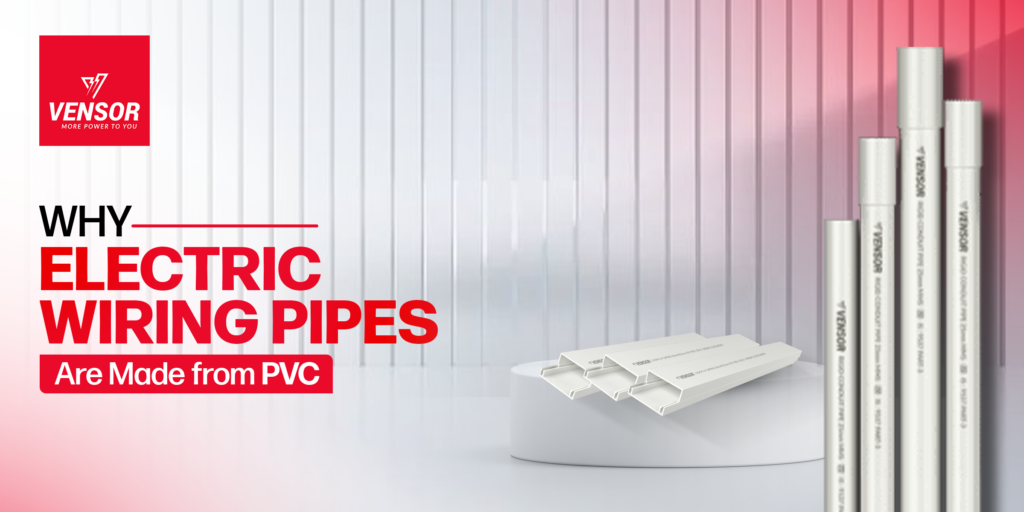
Why do electrical failures still happen even after using branded wires and switches? It is a common assumption that quality components alone guarantee safety, but in reality, nearly 35% of internal electrical faults originate from poor protection and improper routing, not the wire itself.
The real issue begins once wiring is installed. When cables are left exposed to moisture, heat, sharp bends, or physical pressure inside walls, their insulation gradually weakens regardless of how premium the conductor is. Over time, this silent degradation leads to leakage, short circuits, or complete system failure.
This is where electrical planning shifts from product selection to system protection. There is a well-known principle in the industry: “Protection defines performance.” If wiring is the core of an electrical system, then the conduit is the protective layer that ensures its safety, durability, and efficiency.
That is exactly why PVC has become the standard material for electrical wiring pipes across residential, commercial, and industrial installations. It supports the wiring and also ensures protection throughout the entire system lifecycle.
Why Protection Matters More Than Just Wiring?
A properly designed electrical system does not depend only on current flow, but also on how safely that current travels over time. Electrical cables constantly face three major risks:
- Heat build-up due to load variation
- Moisture penetration inside walls or underground lines
- Mechanical damage during construction or later drilling
When these risks are not controlled, insulation begins to weaken, leading to leaks or short circuits.
A high-quality PVC wiring pipe acts as a barrier, isolating cables from external factors and ensuring long-term stability rather than short-term functionality.
Why PVC Is the Preferred Material for Electrical Conduits?
When it comes to safeguarding electrical systems, the choice of conduit plays a decisive role in long-term performance and safety. Among the available materials, PVC has consistently emerged as the most reliable and widely used option.
But what makes PVC the preferred choice across residential, commercial, and industrial projects? Let’s explore the key reasons behind its dominance.
1. Resistance to Moisture and Corrosion
Unlike metal conduits, PVC does not react with water, chemicals, or salts present in construction materials. This becomes especially important in areas such as basements, kitchens, or underground cable routes.
In high-humidity regions, metal pipes often develop internal rust layers, reducing the internal diameter and damaging insulation. PVC maintains a smooth internal surface, allowing cables to remain intact and easy to replace.
2. Controlled Heat Behaviour Without Conductivity
PVC is a non-conductive material that significantly reduces the risk of electric shocks and leakage currents in enclosed wiring systems. In practical installations, this ensures that any fault current remains confined to the conductor and does not energise the conduit or surrounding surfaces.
When current flows through wires, heat is generated, especially in high-load circuits such as air conditioners, geysers, or industrial equipment. A conductive enclosure can allow to transfer outward or create hotspots at contact points.
PVC, however, provides electrical insulation along with thermal stability, helping contain heat within safe limits and preventing it from affecting adjacent materials such as plaster, wood, or insulation layers.
- Structural Flexibility with Strength
PVC pipes offer a balanced combination of rigidity and flexibility. This allows:
- Easy bending during installation without cracking
- Stable alignment inside walls and ceilings
- Reduced joint usage, which lowers leakage risk
In multi-storey projects, this flexibility helps in routing conduits through complex pathways without weakening the structure.
Reliable electrical PVC pipe manufacturers focus on uniform thickness and impact resistance to ensure pipes do not collapse under concrete pressure or external loads.
4. Fire Safety and Self-Extinguishing Properties
Modern PVC conduits are engineered with fire-retardant properties that limit ignition and restrict flame spread. When exposed to fire, they resist sustaining combustion and tend to self-extinguish once the external source is removed.
This behaviour is especially critical in concealed wiring systems, where unnoticed faults can otherwise allow fire to travel through internal pathways and affect multiple sections of a building.
In contrast, conventional conduit materials can enable flame propagation, particularly when cable insulation is damaged or degraded, increasing the risk of fire spreading across circuits and structural areas.
5. Smooth Internal Surface for Cable Longevity
The inner surface of PVC pipes is friction-free, which directly impacts cable life.
During installation, cables pass through long conduit routes. A rough internal surface can damage insulation layers, especially at bends and joints. PVC eliminates this issue, ensuring:
- Easy cable pulling
- No abrasion during installation
- Long-term insulation integrity
This becomes particularly valuable in high-load commercial systems where cable replacement is costly.
The Role of Manufacturing Quality in PVC Conduits
Not all PVC conduits perform the same, their reliability depends heavily on how precisely they are manufactured and the quality of raw materials used.
Top electrical accessories manufacturers ensure:
- Uniform wall thickness for consistent strength and load handling
- High-grade compounds to prevent brittleness and early cracking
- Adequate pressure resistance for concealed and slab installations
- Accurate internal diameter for smooth, damage-free cable routing
This becomes critical in real-world applications. In many older residential buildings, low-grade conduits harden and collapse, making rewiring impossible without breaking walls, thereby adding cost, time, and structural damage during upgrades.
In industrial environments, continuous vibration from machinery can cause cables to shift inside weak conduits, leading to friction, insulation wear, and eventual electrical failure.
High-quality PVC conduits maintain their shape and securely hold cables in place even under such stress. Incidents like the Kamala Mills Fire highlight how gaps in electrical protection and infrastructure can amplify risks in enclosed systems.
This clearly shows that conduit manufacturing quality directly impacts safety, maintenance efficiency, and long-term electrical reliability.
Why PVC Outperforms Traditional Alternatives?
PVC has replaced traditional conduit materials because it delivers consistent performance during installation and long-term use, while offering initial cost benefits. Here’s a clear comparison to understand why:
| Parameter | PVC Conduit | Metal / Traditional Conduit |
| Corrosion Resistance | No rust, unaffected by moisture or chemicals | Prone to rust, especially in damp or industrial environments |
| Weight | Lightweight, easy to handle and install | Heavy, requires more effort and support |
| Installation Time | Faster routing, cutting, and fitting | Slower due to rigidity and handling complexity |
| Internal Surface | Smooth, supports easy cable pulling even after years | Can become rough or corroded, damaging cable insulation |
| Maintenance | Minimal, long-term stability | Higher maintenance due to corrosion and wear |
| Service Life | Long-lasting without degradation | Reduced lifespan in harsh conditions |
This combination of durability, ease of installation, and low maintenance makes PVC a practical necessity in modern electrical planning rather than just a cost-effective alternative.
Final Thought
Electrical safety begins with protection. The conduit chosen defines how well the entire system performs over time.
PVC wiring pipes bring together insulation, durability, flexibility, and safety in a way that no traditional material can match. This is why they have become the backbone of modern electrical infrastructure.
For projects that demand reliability without compromise, Vensor Electricals Pvt. Ltd. provides solutions that protect every connection and circuit. Get in touch today to ensure your electrical systems are built for safety, efficiency, and long-term performance.
Frequently Asked Questions
Why is PVC safer than metal for electrical conduits?
PVC does not conduct electricity, unlike metal pipes, reducing the risk of shock.
Do PVC pipes handle heat from electrical loads?
Yes, PVC resists heat buildup and maintains insulation stability.
Can PVC conduits be used in concealed wiring?
They are ideal for concealed systems due to their durability and corrosion resistance.
How long do PVC wiring pipes last?
High-quality PVC conduits maintain performance for decades without degradation.